
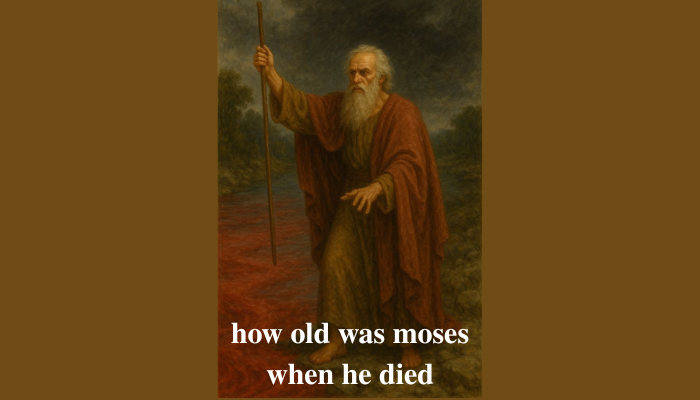

The question of Moses’ age at death has captivated scholars, theologians, and history enthusiasts for centuries. According to the Book of Deuteronomy, how old was moses when he died at the remarkably advanced age of 120 years old. This specific detail appears in Deuteronomy 34:7, which states: “Moses was one hundred and twenty years old when he died. His eyes were not weak nor his strength gone.” This biblical account provides us with concrete information about one of history’s most influential spiritual leaders.
What makes this figure particularly interesting is not simply the number itself, but what it reveals about Moses’ life, his physical condition, and the broader context of his journey. Moses lived an extraordinarily long life by any standard, ancient or modern. His death marked the end of an era and the conclusion of one of the most transformative periods in biblical history.
The Timeline of Moses’ Life
To fully appreciate Moses’ longevity, we need to understand the major phases of his life. According to biblical tradition, Moses lived for exactly 120 years, which some scholars divide into three distinct 40-year periods. This structure appears intentional within the biblical narrative.
The first 40 years of Moses’ life were spent in Egypt, where he was raised in Pharaoh’s household after being rescued from the Nile River. During this period, he received an Egyptian education and lived as a member of the royal family. However, after witnessing the suffering of the Hebrew slaves and killing an Egyptian taskmaster, Moses fled Egypt and spent the next 40 years in exile in Midian.
Physical Condition at Death
One of the most remarkable aspects of the biblical account of Moses’ death is the specific mention of his physical state at 120 years old. The text emphasizes that “his eyes were not weak nor his strength gone.” This statement holds significant meaning because it distinguishes Moses from typical human aging processes.
Ancient texts and rabbinical commentaries have suggested that Moses’ longevity and preserved physical condition were extraordinary even by biblical standards. While other figures in the Hebrew Bible lived long lives, Moses’ combination of extreme longevity and maintained vigor stood out as particularly noteworthy.
Biblical Accounts of Moses’ Death
The biblical narrative describes Moses’ death with remarkable detail and emotional weight. After leading the Hebrew people for 40 years in the wilderness, Moses was positioned to enter the Promised Land. However, this would not happen. According to the biblical account, God instructed Moses to climb Mount Nebo to view the land from a distance, knowing he would not cross over into Canaan.
This command must have carried profound emotional significance. Moses had dedicated his entire adult life to leading his people toward this destination. Yet at the threshold of success, he was called to pass the leadership to Joshua and to view his life’s work from a distance rather than experience it fully.
The Significance of 120 Years
The number 120 appears throughout Jewish tradition as carrying particular significance. Jewish law, as developed in the Talmud, refers to 120 years as the lifespan that represents the completion of human life. The Psalmist wrote, “Our days may come to seventy years, or eighty, if our strength endures,” suggesting that even in biblical times, such ages were considered exceptionally long.
In Jewish mysticism, the number 120 also appears in discussions about the completion of cosmic cycles and the fulfillment of divine plans. Some traditions suggest that 120 represents the maximum years that a human being can be expected to live at full capacity and consciousness.
Comparing Moses’ Age to Other Biblical Figures
By the time of Moses, ages had decreased significantly from the antediluvian period. Most figures in Moses’ era lived considerably shorter lifespans. David, one of Israel’s most celebrated kings who lived centuries after Moses, reportedly lived to about 70 years old, which was considered a full and complete life.
This pattern demonstrates that Moses’ 120 years was exceptional even within the biblical tradition, representing a bridge between the extreme longevity of earlier patriarchs and the more typical human lifespans that followed.
Historical and Archaeological Perspectives
While the Bible provides clear information about Moses’ age at death, historians and archaeologists approach this question with careful analysis. The historicity of Moses remains debated among scholars. Some scholars argue that Moses was a historical figure whose life events are substantially recorded in biblical narratives, while others suggest that the biblical account represents a composite narrative or theological interpretation rather than strictly historical fact.
Many scholars acknowledge that even if the specific biographical details of Moses require careful interpretation, the biblical tradition regarding his age at death appears to be presented as factual information within the narrative framework. The specificity of “120 years” and the notation about his physical condition suggest that these details held meaning within the tradition.
The Legacy of Moses Beyond His Death
While Moses died at 120 years old on Mount Nebo, his legacy extended far beyond his physical lifespan. The Bible states that no one has since arisen in Israel like Moses, indicating his unique place in religious history. His contributions to Jewish law, theology, and practice formed the foundation of Judaism and profoundly influenced Christianity and Islam.
In Jewish tradition, commemoration of Moses occurs annually on the 7th of Adar, which is traditionally held to be his birth and death date. This observance reflects the continuing importance of Moses within Jewish consciousness and practice. Throughout the centuries, rabbinical interpretations have explored the meaning of Moses’ long life, his leadership qualities, and his unique relationship with God.
Conclusion: Understanding Moses’ Lifespan
Moses died at 120 years old, according to the biblical text that has been consistently transmitted through Jewish and Christian traditions. This age, combined with the specific notation that his physical strength remained undiminished, marks Moses as one of the most remarkably preserved humans in historical and religious records.
Whether one approaches this information from a purely historical perspective, a theological perspective, or a combination of both, the figure of 120 years represents an intentional statement within the biblical narrative. It communicates something significant about Moses’ life: it was complete, purposeful, and divinely ordained.